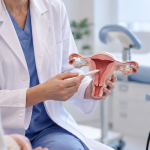

What is an ectopic pregnancy?
An ectopic pregnancy occurs when the embryo is not inside the uterus . The prevalence of this type of pregnancy is 1 in 1000 . In most cases, approximately 95%, the embryo is located in the fallopian tube, although it can also be found in the ovary, the cervix, or even within the myometrium and the fibrous tissue of a cesarean scar.
Why does an ectopic pregnancy occur?
An ectopic pregnancy occurs because, as the previously fertilized egg travels to the uterus through the fallopian tubes, it attaches to another part of the woman's body, primarily the fallopian tube itself.
In these cases, we are faced with a pregnancy that, in principle, is not viable to reach term , since, on the one hand, the embryo will not receive everything necessary to develop and, on the other hand, it poses a huge risk to the mother.
Which are the risk factors?
In general, the following can be described as risk factors for an ectopic pregnancy :
- Having previously suffered another ectopic pregnancy, in the event that you become pregnant before knowing whether the other tube is partially blocked.
- Cases of sterility greater than 2 years.
- Previous illnesses that can cause partial or complete blockage of a fallopian tube, such as endometriosis. Likewise, having a fallopian tube removed.
- Women smokers
- Elderly mothers, over 35 years old.
- Pregnancies resulting from certain fertility treatments.
- Pregnancies that have developed while the mother is carrying an IUD.
- Various diseases: infections in the abdominal cavity (appendicitis), STIs, etc.
- When the pregnant woman has previously undergone surgery in the area, whether through curettage, tubal ligation, etc.
What symptoms does an ectopic pregnancy cause?
As Dr. Vidal explains in an article published in ¡Hola! magazine , ectopic pregnancies are initially asymptomatic. However, a few weeks after a positive pregnancy test, the first symptom can be severe pain in the lower pelvis, sometimes accompanied by bleeding, lightheadedness, dizziness, rectal pressure, and shoulder pain. This can be due to a ruptured fallopian tube, and therefore, if you experience these symptoms, you should go to the emergency room immediately.
In these cases, if a fallopian tube ruptures , a surgical procedure is performed using laparoscopy . Furthermore, depending on the severity, one of the possible consequences can be infertility, due to the loss of one tube and damage to the other. If detected early, medical treatment with methotrexate can be initiated, along with regular checkups.
Can it be prevented?
As Dr. Vidal explains, to prevent a possible ectopic pregnancy, a prenatal ultrasound and/or contrast X-ray can be performed to assess the condition of the fallopian tubes and detect any blockages. If blockages are found, in vitro fertilization (IVF) treatment would be necessary.
Related articles
If you found this article interesting and would like to be seen by a specialist in Gynecology and Obstetrics, the Women's Unit at Ruber International Hospital has a specialized department in this area. You can request more information by calling 91 387 51 72/73/74 or schedule an in-person appointment with top specialists.